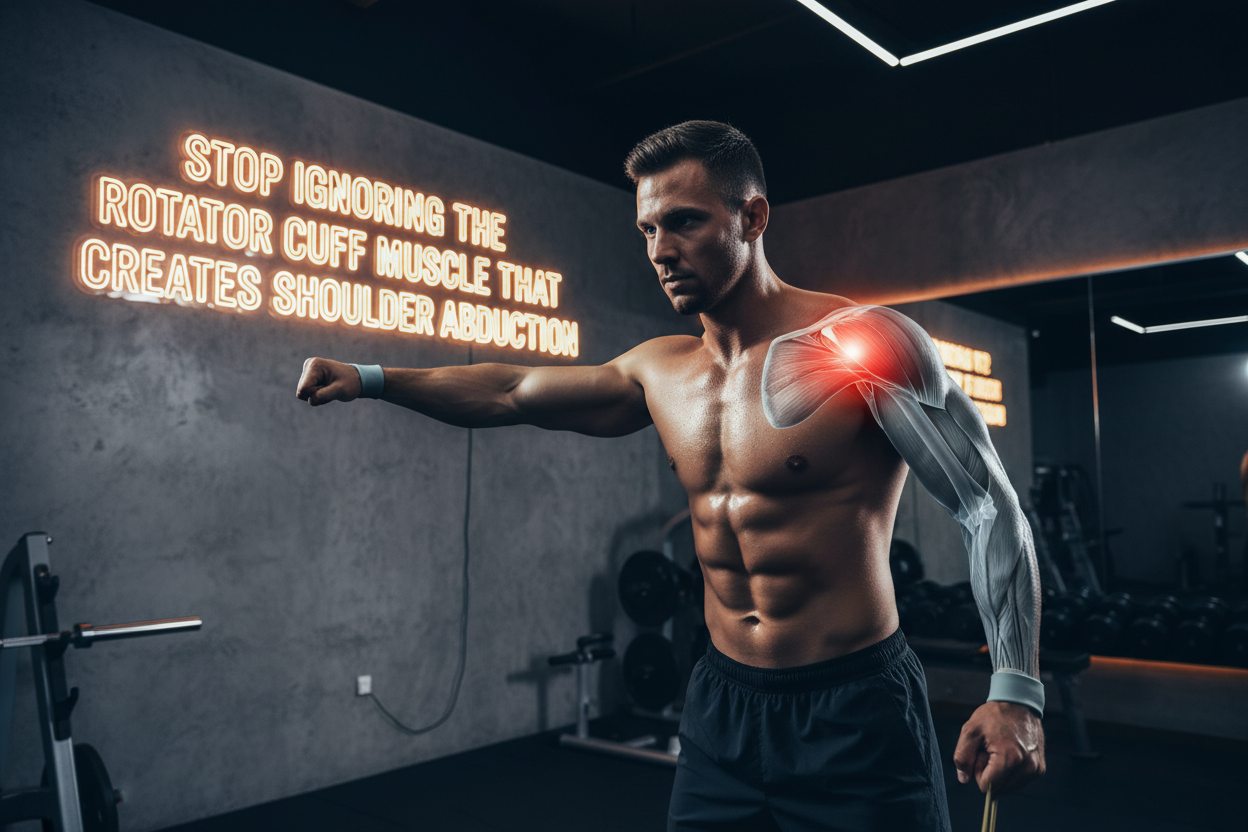
Stop Ignoring The Rotator Cuff Muscle That Creates Shoulder Abduction
If you have ever felt a sharp pinch deep in your shoulder while lifting your arm to the side, you have likely introduced yourself to the specific anatomy we are discussing today. Many athletes assume the deltoids do all the heavy lifting, but there is a crucial stabilizer working behind the scenes. Specifically, you need to know which rotator cuff muscle creates shoulder abduction to prevent impingement and build a bulletproof upper body.
Understanding this mechanism isn't just for anatomy nerds; it is the difference between healthy overhead pressing and chronic nagging pain. Let’s break down the mechanics, the specific muscle responsible, and how to train it without wrecking your joints.
Quick Summary: The Anatomy of Abduction
- The Primary Initiator: The Supraspinatus is the specific rotator cuff muscle responsible for initiating shoulder abduction.
- The Range of Motion: It is primarily responsible for the first 0 to 15 (sometimes up to 30) degrees of movement away from the body.
- The Handoff: After roughly 15 degrees, the middle deltoid becomes the primary mover, but the supraspinatus remains active to stabilize the humeral head.
- The Function: It acts as a spark plug for movement and compresses the shoulder joint to prevent the bone from sliding upward and hitting the acromion.
The Supraspinatus: The Silent Starter
When asking which rotator cuff muscle abducts the shoulder, the answer is the Supraspinatus. It is the smallest of the four rotator cuff muscles, sitting snugly at the top of the scapula (shoulder blade).
Here is the science of why this matters. Think of your arm bone (humerus) like a golf ball sitting on a tee (the socket). If you just use your big deltoid muscles to pull the arm up, the "golf ball" tends to roll upward and crash into the bony roof of your shoulder (the acromion).
The Supraspinatus pulls the head of the humerus inward against the socket. It initiates the lift—**rotator cuff abduction**—and holds the ball on the tee so it spins perfectly without jamming upward. Without this muscle firing first, you get mechanical impingement.
Why It’s Not the Deltoid
This is a common misconception. While the middle deltoid is the powerhouse that lifts your arm to 90 degrees and beyond, it has a poor mechanical advantage when your arm is hanging straight down at your side.
The Supraspinatus has the perfect leverage to start the movement. It handles the "liftoff." If your Supraspinatus is weak or torn, you might see someone do a "shoulder hike"—shrugging their trap just to get the arm moving. That is a classic sign of dysfunction in the rotator cuff muscle that abducts the arm.
The "Painful Arc" and Impingement
Because the Supraspinatus lives in a cramped space under the acromion bone, it is highly susceptible to wear and tear. If you experience pain specifically when lifting your arm between 60 and 120 degrees, this is clinically known as the "Painful Arc."
This usually suggests that the Supraspinatus tendon is swollen or irritated. When you abduct the arm, that swollen tendon gets pinched. Strengthening this muscle isn't about moving heavy weight; it is about teaching the muscle to fire before the deltoid takes over.
How to Train for Stability (Not Just Strength)
Forget heavy lateral raises for a moment. To target this specific muscle, you need finesse.
The "Full Can" Exercise
Years ago, the "Empty Can" exercise (thumbs down) was popular. We now know this increases the risk of impingement. Instead, use the "Full Can" variation:
- Stand with a light dumbbell (2–5 lbs max).
- Position your arm 30 degrees forward (in the scapular plane).
- Raise the thumb up toward the ceiling, stopping at shoulder height.
- Focus on the first few inches of the movement.
My Training Log: Real Talk
I want to share my personal experience with which rotator cuff muscle creates shoulder abduction, because knowing the anatomy is different from feeling it fail.
A few years back, I was pushing heavy on overhead press volume. I started noticing a weird, dull ache—not in the deltoid, but deep inside the shoulder, almost feeling like it was under my upper trap. I ignored it. Then, during a warm-up set of lateral raises, I felt a distinct "catch." It wasn't a snap, but a momentary loss of power where my arm just wouldn't go up without me shrugging my neck.
That was the Supraspinatus checking out. The most humbling part of rehab wasn't the pain; it was the weight. I had to drop from 30lb dumbbells to a 2lb pink vinyl dumbbell to do "Full Cans." The specific sensation of the Supraspinatus working is unique—it doesn't burn like a bicep curl. It feels like a deep, fatigue-induced tremble right near the base of the neck. If you don't feel that specific, boring stability fatigue, you are likely compensating with your traps or delts.
Conclusion
Identifying the Supraspinatus as the muscle responsible for shoulder abduction is step one. Step two is respecting it. It is a small muscle with a big job: steering the shoulder joint so the big muscles can generate power. Treat it with controlled, light movements, and your heavy pressing will actually improve because your stability foundation is solid.
Frequently Asked Questions
Which rotator cuff muscle initiates abduction?
The Supraspinatus is the primary initiator of shoulder abduction. It is responsible for the first 15 degrees of movement before the deltoid muscle takes over the primary lifting role.
Do the other rotator cuff muscles help with abduction?
While the Supraspinatus creates the abduction, the other three cuff muscles (Infraspinatus, Teres Minor, and Subscapularis) work simultaneously to pull the humeral head down and inward. This stabilizes the joint, allowing the abduction to occur smoothly without dislocation or impingement.
Can I abduct my arm if the Supraspinatus is torn?
Yes, but it is difficult and often painful. You will likely use a "trick movement" by shrugging your shoulder (using the trapezius) or leaning your body to the side to use momentum to get the arm past the first 15 degrees, allowing the deltoid to engage.